
Building My First FPV Drone
Documenting my drone-building journey.

This post documents my drone-building journey. It’s not a tutorial on how to build a drone, but I’ll share the kit and guide I followed in case you're curious.
My background is in software and machine learning. I currently work in fintech, but I’ve always been drawn to hard tech, especially rockets, drones, and deep learning. One day, I’d love to join a local rocket club and build a model rocket. With my current skill set, embedded systems are probably the most approachable way for me to break into hard tech.
So I set out to learn about flight controllers as my first step into embedded systems. The plan somehow evolved into building an FPV drone, with the actual flight controller programming likely coming next.
I’ve always been into drones. My first exposure was flying a DJI Mavic Air, where I just wanted to create some aerial shots. I brought it to Iceland and shot my first drone footage there:
After doing some research, I decided to get a DIY Drone Kit from GetFPV, which comes with an accompanying build tutorial. It includes all the components that are mutually compatible. I figured this would be a good way to learn the basics before sourcing my own parts and building a fully customized drone.
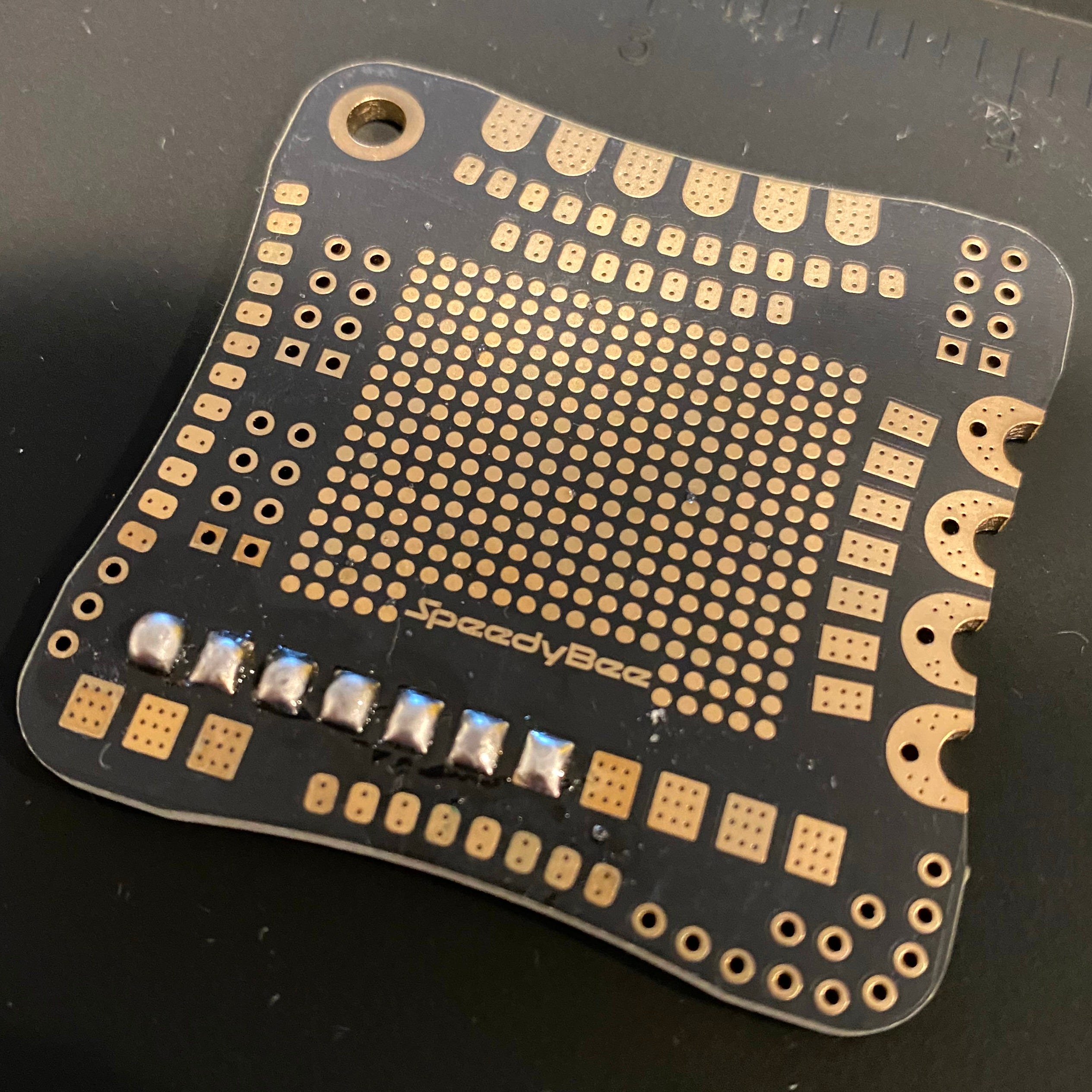
The most challenging part was probably soldering. The only soldering I’d done before was for stained glass, and that was back in high school. I spent a few sessions practicing on a PCB practice board before working on the actual components. There’s still a lot of room for improvement, but at least I didn’t short-circuit or damage any components.
It wasn’t until I finished building and tried flying it that I realized just how much assistance a DJI drone provides. In short, a DJI drone abstracts away most of the complexity and lets you simply control where you want the drone to go. An FPV drone, on the other hand, gives you direct control over the rate of rotation on each axis and the throttle. I tried hovering it in my apartment, and I could tell right away, based on how the drone jerked from even the tiniest input, that there was no way I could fly it indoors without breaking something.
This drone I built is an FPV quad, with a flight controller designed primarily for manual flight using firmware like Betaflight. It was a great introduction to hardware assembly and flight control systems. But if I want to dig deeper into autonomous flight, such as GPS-guided takeoff, position hold, mission-based navigation, and autonomous landing, I’ll need a different flight controller, additional sensors, and a more advanced software stack like ArduPilot or PX4. I still hop into the simulator to practice flying from time to time, but now that I’ve gotten the basics down, I’ll eventually move on to a flight stack like ArduPilot or PX4 to focus more on flight controller programming.
Resources:
Build Photos:


